Thursday, July 7, 2011

Forensic tests for the presence of blood


Part 30 in the Knox/Sollecito case
Updated three times (see below)

Introduction
Blood has a high proportion of red blood cells that are packed with a protein called hemoglobin but are without DNA. Hemoglobin has a helper molecule called heme, which contains iron, and the iron binds and releases oxygen. Roughly 1 in 800 blood cells is a white blood cell that does not have hemoglobin but does have DNA. The detection of blood is an ongoing problem in forensic science, and advances are continually being made. A previous entry in this blog also treated luminol.

Presumptive tests
Two major kinds of presumptive tests are chemiluminescent and chemical. Presumptive tests rely upon the pseudoperoxidase acivity of hemoglobin. Hemoglobin is not an enzyme (catalyst) in its role carrying oxygen, but it can often speed up the reaction of hydrogen peroxide with a reduced molecule. In these tests hemoglobin is mimicking the action of a class of enzymes called peroxidases, thus one refers to the pseudoperoxidase activity of hemoglobin. Peroxidases oxidize organic molecules using peroxides (such as hydrogen peroxide) as the oxidant. Luminol is chemiluminescent, giving off a bluish light in the presence of dilute blood when it is oxidized. Tetramethylbenzidine (TMB) is a chemical test, relying upon a change in color upon oxidation.

The murder of Meredith Kercher may have featured a misuse of the Kastle-Meyer test, a presumptive test for blood. The Kastle-Meyer chemical test relies upon hydrogen peroxide oxidizing phenolphthalin, which is colorless, to phenolphthalein, which is pink.

The police released photos (see above) to the press that some observers, such as Judy Bachrach of Vanity Fair, thought was blood. Based on the discrepancy between Ms. Knox’s description of the bathroom and its seemingly bloody appearance, some observers lost trust in Ms. Knox.***

The actual appearance of the bathroom was unremarkable, except for a small number of droplets of blood and a partial footprint that may have been made in bloody water.
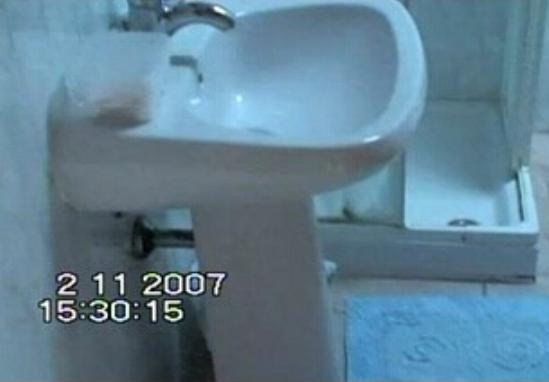
However the pink color may have been from using the Kastle-Meyer reagent over a large surface area and allowing air to oxidize the phenolphthalin. However, the color may have instead been the result of reagents used for latent fingerprint analysis. The pink photo at the top of this page was apparently not entered into evidence at the trial.

Confirmatory tests
Confirmatory tests are typically run after presumptive tests have given a positive result. Their purpose is to distinguish blood from substances that can give false positives for blood. Forensic scientists Dr. Kelly Virkler and Dr. Igor Lednev identify five classes of confirmatory tests: microscope tests, crystal tests, spectroscopic methods, immunological tests, and chromatographic methods. Crystal tests are based on the formation of crystals of heme (or a pyridine-based derivative of heme), and they are not performed as much as in previous years. Immunological tests that are based upon antibodies (immunoglobulins) that bind to hemoglobin, lactate dehydrogenase (more specifically, the distribution of the isozymes of lactate dehydrogenase), glycophorin A, or other biomolecules are more recent innovations. There are many methods which employ antibodies, such as the early double diffusion (Ouchterlony) experiments and more recent immunochemical techniques, such as enzyme-linked immunosorbent assays (ELISAs).

False Positives and the language of forensic reports
Presumptive tests will often give false positives in presence of metal ions or plant material containing peroxidases. Drano and bleach are two of several household products that can yield a false positive with luminol, as noted by Lt. Robin Bratton. Some of the putative bloodstains in the Lindy Chamberlain case (in which she was wrongfully convicted of murdering her infant) may have been the result of copper dust from the atmosphere, discussed by Dr. R. V. Winchester. The Chamberlains lived in Mt Isa, which is home to copper mines.

The case of Greg Taylor in North Carolina illustrates how one’s fate can turn on the choice of which information is revealed and the choice of words the forensic scientists use to convey the results. Joseph Neff and Mandy Locke wrote, “In Taylor's case, an alleged blood stain was the only physical evidence tying him to the murder. The presumptive test was positive; the confirmatory test was negative. The lab report made no mention of the negative confirmatory test…The FBI's written policy directed the analyst first to report the positive presumptive test results. If the confirmatory test is negative, the analyst would write, ‘Further testing could not confirm the presence of human blood.’” Some problems that can arise when a confirmatory test is negative are discussed in Appendix A.

The luminol-positive areas in the murder of Meredith Kercher
There were two luminol-positive areas in Filomena’s room, and both contained mixtures of DNA (the DNA mixtures will be treated in a separate blog article). There were three footprints in the hallway, and all tested negative for DNA. There was also a shoe print that contained both Meredith’s and Amanda’s DNA.

It emerged during the trial that the luminol-positive areas that contained DNA were subjected to a second presumptive blood test, tetramethylbenzidine (TMB). Dr. Sarah Gino noted in her testimony that TMB is negative about 50% of the time when luminol-positive areas are tested (Massei Motivations Report, p. 258, English Translation). Although luminol is more sensitive than TMB, TMB can detect blood that has been diluted up to 10,000-fold.

It is sometimes argued that negative TMB results in the Kercher case can be ascribed to this difference in sensitivity. There are several reasons to reject this explanation. First, if it were the only explanation for TMB giving a negative result, no forensic personnel would ever use TMB after using luminol: A negative result would not rule out the presence of blood, yet a positive result would still require a confirmatory test afterwards. Second, the window of dilution factors for which one would expect a positive luminol reaction but a negative TMB reaction is relatively small. Third, if one did have a sample which fell into this range, the luminol response would be weak, whereas Colonel Garofano remarked upon the sheer luminosity* of the footprints in the book Darkness Descending. A study by Bilous and coworkers showed that the maximum intensity of light emitted fell with decreasing concentration of blood (see Table 1).

With respect to the luminol-positive/TMB-negative/DNA-negative areas, I asked the authors of a recent study on the forensics of body fluid identification for their interpretation. Drs. Virkler and Lednev wrote, “So, there was either no blood and the luminol was wrong, or there was blood and the TMB had interference and the luminol damaged the DNA. We think it is more likely that there was no blood, and that the luminol was reacting with something else, possibly plant matter from the bottom of the shoes causing the footprints (the intensity of the luminol reaction might give some more insight). The prosecution should have used much more convincing evidence to prove the presence of blood.”

Were the luminol-positive areas related to the crime?
The footprints in the hallway are all right feet images** and do not form a trail. No reference footprints were taken from anyone except Amanda, Raffaele, and Rudi, nor can the prints be dated. Yet Judge Massei regards the prints as being made in blood. He said (p. 284 in the English translation of the Massei Motivations Report), “In this regard, one cannot simply disregard the fact that the bloodstains were undeniably abundant in Meredith’s room, from which easily, or indeed inevitably, they must have been exported to other parts of the house by anyone who, coming out of Meredith’s room, went into these other parts.” In some respects this line of reasoning is similar to Dr. Stefanoni’s argument in front of Judge Micheli during the pretrial, as reported in Candace Dempsey’s blog, Let's Talk About True Crime. This argument is extremely poor. It suggests that the footprints should form a continuous trail of right and left footprints away from Meredith’s room, contrary to fact. It treats luminol as if it were a confirmatory test for blood, and it ignores the negative TMB testing that was done on at least some of the luminol-positive areas.

Finally, two other facts lead one to question whether the luminol-positive spots are related to the crime. One is that the luminol data were collected on December 18, not in early November right after the crime but rather after the police had tossed the crime scene. This means that law enforcement personnel may have tracked luminol-positive material into Filomena’s room, for example. Two is that the police found many luminol-positive areas in Sollecito’s flat. There is no reason to associate any of these regions with the murder, and Sarah Gino’s testimony suggests that luminol-positive areas are not uncommon in forensic investigations.

The relationship between DNA testing and confirmatory blood testing
Although DNA typing is a powerful tool in forensics, it is not a test for blood. The National Forensic Science Technology Center said, “For example, while examining the clothing of a suspect, a forensic biologist might visually locate a brown stain that presumptively tested positive for blood and was then DNA typed. The DNA type is found to match the victim. Knowing that the loci tested are higher primate specific, what conclusions can be drawn? The only unqualified conclusion that can be offered is that the stain contains DNA that matches the victim. It has not been proven to be blood.” In response to a question of mine, Dr. Virkler and Dr. Lednev concurred: “It is correct to assume that DNA profiling is not a confirmatory test for blood because it can be found in so many other things. Just confirming the presence of the victim or suspect's DNA has absolutely no bearing on what type of tissue or fluid it is. There could have been skin cells scattered in a pile of ketchup that would match a person's DNA, but that doesn't make it blood.”

In "An Independent of the SBI forensic laboratory" in North Carolina, Chris Swecker and Michael Wolf stated, “It should be noted that the confirmatory ‘Takayama’ blood test that was at issue in the Taylor Innocence Commission proceedings was discontinued in 2003 and replaced with DNA and rapid Stain identification tests.” The Rapid Stain kit manufactured by Independent Forensics of Hillside, IL “uses two mouse monoclonal antibodies specific for human glycophorin A.” Glycophorin A is a protein found on the membranes of red blood cells.

The lack of DNA in a sample suggests that a substance is not blood, but that relationship is not absolute. The sample might contain an inhibitor of the polymerase chain reaction needed to amplify DNA in present-day DNA forensics or the presumptive test itself may have an effect on the DNA profiling. The exact formulation of luminol affects how much DNA is recovered.

Update 2, 6 PM 7/8/11
Conclusions
The luminol-positive areas can be subdivided into those that did and those that did not have DNA. The amorphous regions in Filomena’s room fall into the former category, and the footprints in the hallway fall into the latter category. However, none was subjected to a confirmatory test for blood, and none should be concluded to be blood. The presence of DNA in some of the areas does not constitute a confirmatory test; additionally, the areas with DNA were negative in the TMB tests. The other luminol-positive areas were not confirmed to be blood. Ms. Comodi asked for the jury to decide whether or not the areas were blood. The jury should not have concluded that any luminol-positive area was blood, and that is one reason that the notion that these areas were mixed blood is a fallacy. We will explore this erroneous notion in a subsequent entry.

***A previous version of this sentence was incomplete. It read, "Based on the discrepancy between Ms. Knox’s description of the bathroom and its seemingly bloody appearance." I completed the sentence and added a link to a discussion board.

Update 1 7/7/11, 2 PM EDT
*On page 377 in the book Darkness Descending, Colonel Garofano discussed the luminol-positive prints in Amanda's room and the prints attributed to her in the hallway: "FIrst of all, from their sheer luminosity they are blood. The DNA test showed Meredith's blood in all cases except for two places in which we have a mixed Amanda and Meredith sample." Colonel Garofano's statement implies that the luminol-positive areas all had Meredith's DNA, which is false. They also seem to equate a hypothetically presence of DNA as meaning that blood is also present, and this is also false, as discussed above. Thanks to Rose Montague for asking for the exact quote.
**A reader suggested a different wording, such as "each footprint in the hallway is a right-foot image," would be clearer. I am grateful for this suggestion.

Update 3 6 PM 7/12/11
I added two links on Drs. Virkler and Lednev.

Appendix A, Forensic bias and confirmatory blood tests
The Raleigh News and Observer reported, “Jed Taub, a 30-year veteran of the SBI, said, ’We didn't report the negative result of a confirmatory test because, really, it's misleading,’ said Taub, who now works as a forensic investigator for the Pitt County Sheriff's Office. ‘We couldn't be sure it wasn't blood, so those tests really didn't matter.’’ Reporters Mandy Locke and Joseph Neff continued, “Taub said that the only times he reported the absence of blood was when he got a negative result on that first, presumptive test. Any negative results after that were irrelevant, he said.”

In another article in the series on North Carolina’s SBI forensic laboratory Neff and Locke reported, “Perhaps the biggest challenge facing new SBI Director Greg McLeod is changing the culture of the SBI and the laboratory. Analysts have worked to support the theories of prosecutors, instead of rendering detached scientific analysis. Training manuals, some which have been withdrawn, have coached analysts to support prosecutors and distrust defense attorneys. This bias extended down to the very way analysts reported test results. ‘They were writing reports to law enforcement,’ said Chris Swecker, the former FBI supervisor who audited the blood cases. ‘They were trying not to write any negative test results.’”

These stories suggest that some aspects of forensic bias can be traced to the close relationship between law enforcement and forensic science laboratories. With respect to the forensics there is nothing that happened in Perugia that could not happen in the United States.

Appendix B, Some other presumptive and confirmatory tests

Leucomalachite green: Hemoglobin catalyzes the oxidation of the reduced form of leucomalachite green to the oxidized form, much as in the Kastle-Meyer test.

Leucocrystal violet: This test is very similar to the leucomalachite green test.

Takayama crystal tests: The sensitivity is about 0.001 mL of blood or 0.1 mg of haemoglobin. The crystals are pink in color.

Wednesday, June 29, 2011

The Independent DNA Experts Weigh In

Part 29 in the Knox/Sollecito case

Judge Hellmann, who is presiding over the appeal, appointed Conti and Carla Vecchiotti as independent experts to review the bra clasp and knife DNA evidence. The translation of their conclusions was provided by komponisto, who also authored “The Amanda Knox Test.” Their report will be discussed in court next month. The formatting (bold or italics) is in the original.


CONCLUSIONS

Based on the considerations explained above, we are able to respond as follows to the inquiries posed at the assignment hearing:

"Having examined the record and conducted such technical investigations as shall be necessary, the Expert Panel shall ascertain:

1. whether it is possible, by means of a new technical analysis, to identify the DNA present on items 165b (bra clasp) and 36 (knife), and to determine the reliability of any such identification"


- The tests that we conducted to determine the presence of blood on item 36 (knife) and item 165B (bra clasps) yielded a negative result.

- The cytomorphological tests on the items did not reveal the presence of cellular material. Some samples of item 36 (knife), in particular sample "H", present granules with a circular/hexagonal characteristic morphology with a cental radial structure. A more detailed microscopic study, together with the consultation of data in the literature, allowed us to ascertain that the structures in question are attributable to granules of starch, thus matter of a vegetable nature.

- The quantification of the extracts obtained from the samples obtained from item 36 (knife) and item 165B (bra clasps), conducted via Real Time PCR, did not reveal the presence of DNA.

- In view of the absence of DNA in the extracts that we obtained, with the agreement of the consultants for the parties, we did not proceed to the subsequent amplification step.

2. "if it is not possible to carry out a new technical analysis, shall evaluate, on the basis of the record, the degree of reliability of the genetic analysis performed by the Scientific Police on the aforementioned items, including with respect to possible contamination."

Having examined the record and the relevant documents, we are able to report the following conclusions regarding the laboratory analyses performed on Item 36 (knife) and Item 165B (bra clasps):

ITEM 36 (KNIFE)

Relative to the genetic analysis performed on trace A (handle of the knife), we agree with the conclusion reached by the Technical Consultant regarding the attribution of the genetic profile obtained from these samples to Amanda Marie Knox.

Relative to trace B (blade of the knife) we find that the technical analyses performed are not reliable for the following reasons:

1. There does not exist evidence which scientifically confirms that trace B (blade of knife) is the product of blood.

2. The electrophoretic profiles exhibited reveal that the sample indicated by the letter B (blade of knife) was a Low Copy Number (LCN) sample, and, as such, all of the precautions indicated by the international scientific community should have been applied.

3. Taking into account that none of the recommendations of the international scientific community relative to the treatment of Low Copy Number (LCN) samples were followed, we do not accept the conclusions regarding the certain attribution of the profile found on trace B (blade of knife) to the victim Meredith Susanna Cara Kercher, since the genetic profile, as obtained, appears unreliable insofar as it is not supported by scientifically validated analysis;

4. International protocols of inspection, collection, and sampling were not followed;

5. It cannot be ruled out that the result obtained from sample B (blade of knife) derives from contamination in some phase of the collection and/or handling and/or analyses performed.


ITEM 165B (BRA CLASPS)

Relative to Item 165B (bra clasps), we find that the technical analysis is not reliable for the following reasons:

1. There does not exist evidence which scientifically confirms the presence of supposed flaking cells on the item;

2. There was an erroneous interpretation of the electrophoretic profile of the autosomic STRs;

3. There was an erroneous interpretation of the electrophoretic profile relative to the Y chromosome;

4. The international protocols for inspection, collection, and sampling of the item were not followed;

5. It cannot be ruled out that the results obtained derive from environmental contamination and/or contamination in some phase of the collection and/or handling of the item.

THE EXPERTS

Prof. Carla Vecchiotti

Prof. Stefano Conti

Monday, May 16, 2011

The Independent DNA Experts and the Electronic Data Files

Part 28 in the Knox/Sollecito case

Update, 13 June 2011

In the story “Knox appeal: DNA experts to request more time” from the AFP on 20 May 2011, Knox lawyer Carlo Dalla Vedova said “The experts asked the forensic police to hand over information essential to their report on the DNA. They still haven't received it and will therefore request a 40 days extension.” He added, “It's not the first time we've asked for the police to hand over this information,” He also said, “But they need the raw data they have asked for from the police to do so. We first asked for it in 2009 and it's still not been handed over.” This ends the debate about whether or not the forensic files were ever released to the defense during the trial of the first instance.
____________________

Judge Hellmann appointed two independent experts to review the DNA forensic evidence in Amanda Knox’s and Raffaele Sollecito’s appeal. Recently, the experts asked for more time, and reports suggested that they did not yet have access to documents the felt were necessary to carry out this task.

According to Candace Dempsey, forensic scientist under whose supervision the tests were carried out, Dr. Patrizia Stefanoni, turned aside this request. She wrote to Judge Hellman, “In reference to the request of acquisition of CD RAW DATA, one is obligated to explain that the information in the form of this file in the sequencer is never an integral part of the technical report, as far as the object being tested by the forensic geneticist, namely the DNA profile, and that it is already reported in the electropherogram printout, connected to the technical report on which all of the useful date and an evaluation of the genetic profile are reported… Finally, the request asked for by the expert consultants relative to the acquisition of the CD RAW DATA appears incomplete in so much as the name of the ‘sample file’ requested was not specified…”

To help me consider Dr. Stefanoni's refusal refusal, I have consulted with DNA forensics professionals Dan Krane and Jason Gilder of Forensic Bioinformatics, and I gratefully acknowledge their help. The continued lack of file release with respect to the DNA profiling of this case has been a recurring theme of this blog.

Her arguments against releasing further information are essentially:
(1) All of the necessary data are already in the paper printouts of the electropherograms.
(2) The request for data files is insufficiently specific.

Let us examine point (1) first. Dr. Stefanoni’s position appears to be the same as it was when Dr. Pascali was refused data, as noted in Raffaele’s appeal. Yet some of the electropherograms only provide the number of repeats, not the peak height for each peak. Peak heights are essential to evaluate peak height imbalance within a locus, which bears on the question of whether or not a sample is in the low-template range, and whether two peaks within a locus belong to the same or to two different individuals. Peak heights can also be used to quantify the severity of degradation when one compares DNA fragments of different lengths. Peak height ratios also help one to decide whether or not a small peak is a type of artifact known as a stutter. A careful examination of these small peaks is especially important in helping to judge what other DNA is present on the bra clasp besides Meredith’s and presumably Raffaele’s.

In addition, having the electronic data files allows one to calculate a run-specific limit of detection (Gilder et al., J. Forensic Science, January 2007, 52 (1), 97). This process sets a lower limit on the size of which peaks to accept, based on the amount of noise.

It can also be helpful in detecting a type of artifact known as a pull-up. There are four types of dyes used in DNA profiling, each with a different wavelength (color) of detection. Each dye is ordinarily detected in its own channel. Sometimes a large peak gives a small spurious signal because of bleeding from one channel into another (Butler, Forensic DNA Typing (2005), pp. 336-337; 384). According to Christine Funk and Dr. Simon Ford, “Pull-up can usually be identified through careful analysis of the position of peaks across the color spectrum, but there is a danger that pull-up will go unrecognized, particularly when the result it produces is consistent with what the analyst expected or wanted to find.”

Dan Krane was asked to give his opinion about the release of such files in a separate legal matter. He wrote, “I believe that a defense expert cannot competently evaluate the results of an STR DNA test without having access to the test’s underlying electronic data. In my experience, review of electronic data has often led directly to the discovery of important problems or limitations in the STR testing, or to alternative theories of the evidence, that would not have been apparent based on a review of laboratory reports or other laboratory records… In my opinion, review of the electronic data is as important as review of the laboratory’s written notes…There is no legitimate reason for a laboratory to refuse a defendant’s request to examine the electronic data.” (bolding mine) Finally, this blog has previously noted that the ABA standards explicitly call for release of the electronic data files.

Point (2) is equally difficult to comprehend. Clearly Dr. Stefanoni understands that the electronic data files are being requested, yet apparently wants specific file names. It is difficult to see how the independent scientists would know the file naming convention used in Dr. Stefanoni’s lab. Who does Dr. Stefanoni think can provide the specific file names?

Forensic Bioinformatics has a 10-point standard discovery motion, and point 6 covers files. The material should include:
(6.1) All collection files (such as injection lists and log files for an ABI 310 analysis).
(6.2) All GeneScan® files, including sample files and project files.
(6.3) All Genotyper® files, including templates/macros (see Request 5).
(6.4) All GeneMapper® files, including sample files (.fsa files) and project files (.ser files).
(6.5) If the data you are providing includes files from another case that are not pertinent to the instant case (e.g., sample files from another case included in the same run folder), then please identify those non-pertinent samples by name and laboratory code.

Clearly it is the job of the laboratory that performed the test to provide the file names.

Concluding remarks
The failure of Dr. Stefanoni’s laboratory to provide the data to the independent forensic scientists is a continuation of her refusal to provide them to the defense. There is absolutely no legitimate reason for her to do so. As Dan Krane noted, “It is a fundamental tenet of science that two reasonable experts should be able to independently arrive at the same conclusions after reviewing the same experimental data.”

Thursday, March 17, 2011

An analysis of the bra clasp DNA

Part 27 in the Knox/Sollecito case

Update (7 July 2012)

Some time ago I reviewed some passages in the English translation of the Massei report that concern the bra clasp DNA and examined better electropherograms.  I would like to discuss these without revealing the reference profiles of any of the individuals.  The interested reader should also consult the translation of the Conti-Vecchiotti report and this blog.

Stutter peaks
On page 206 Stefanoni used the word “noise” in a different manner from the way a spectroscopist would use it. From page 207, “Thus, where there is an allele which has a certain height and such that the peak just before it has a much smaller height, at most 15% of the first one, then the previous peak should be considered noise, just a by-product of the analysis.” One infers that Stefanoni used the word noise to refer to stutter peaks and possibly to refer to other artifacts such as blobs. Tagliabracci also used the word noise to mean stutter on p. 241.

If an allele is found at 17 repeats, one expects to see a peak at 16 repeats that is less than 15% the intensity of the peak at 15 but rarely does one see a stutter peak at 18 repeats.  The basis of stutter is that the primer and the template DNA strands do not always anneal perfectly in the DNA replication process. It is far more likely that the bulge of one extra repeat unit will occur on the template strand than on the primer strand, and that is why the stutter peak almost always has one repeat unit less than the true allele.

A problem for a forensic DNA scientist is that when a mixture consists of one strong and one weak profile, discriminating between the weak profile and the stutter peaks is very challenging.  John Butler (p. 125) wrote, “Mixture interpretation requires a good understanding of the behavior of stutter products in single source samples.”

Threshold values
On page 207 one reads, “The height which is considered reliable for a peak to be qualified as an allele is equal to 50 RFU, the symbol RFU representing the unit of measure employed for these measurements.” This is a remarkable statement in one respect, inasmuch as if Stefanoni actually adhered to it, about 22 of about 29 peaks attributed to Meredith on the knife profile would fail to be scored. In other words, she did not respect her own minimum threshold value in at least one other experiment.

Interpretations
On pages 208-209, one encounters some strange statements. “She was asked if she had considered that peak, number 13 [This peak is in locus D5S818 and its height is 108 RFU], as an allele or as noise. Dr Stefanoni declared that she had not considered that peak as an allele or as noise… it can't be an allele because it is too low with respect to the main peaks.” This argument does not make sense; either a peak is an artifact or it is real. It is not in the correct position to be stutter, and there is no reason why a true allele can’t be smaller than Meredith’s profile. Moreover Tagliabracci questioned Stefanoni’s interpretation of this allele (pp. 241-242), noting that in locus vWA that she had taken a peak of only 65 RFU as an allele. Stefanoni argued that each peak should be judged on a case-by-case basis (p. 209), including information such as the main peak heights. Yet the main peaks in vWA are 84% as high as the main peaks in D5S818 on average, whereas 65 RFU is only 60% of 108 RFU. In other words what objective criterion Dr. Stefanoni used to reject a peak of 108 RFU and keep a peak of 65 RFU is obscure or nonexistent. Finally, there are other peaks in vWA at 17 and 18 repeats that are not labeled yet the larger of the two is about 50 RFU. It is difficult to see why this peak was not considered an allele.

Stefanoni was asked about an alternate interpretation, one in which a minor contributor would have the alleles 12 and 13. “In response to this question-observation, Dr Stefanoni explained that in this case, it would not be possible to explain the Y chromosome, and thus reaffirmed the correctness of the interpretation she had given.” It sounds as if Stefanoni used her attribution of the Y-chromosome profile to Raffaele to then interpret the autosomal DNA as having his profile.

Locus D21S11 is problematic (pp. 241-242). Stefanoni counted as stutter a peak that is 15.6% the height of the next peak. That is higher than the 15% cutoff, which is higher than stutter with which I am familiar. But she counted as real a peak that is 17.2% of the next peak, which is not that much of a difference. This peak could constitute half of Raffaele’s profile in this locus, but the other half would fall underneath one of Meredith’s two peaks, which are roughly sixfold higher. Although it is possible that Raffaele’s other allele is present and contributes additional intensity to the second of the two large peaks belonging to Meredith, I don’t see any reason to assume that it must.

There are peaks on the bra clasp electropherogram that are not part of Raffaele’s profile and are not stutter. In reviewing the bra clasp DNA, I am more concerned than I was before that Stefanoni applied a suspect-centered approach, which would be contrary to good forensic practice.


Introduction
A previous post has examined the DNA on the bra clasp, which has a strong profile from the victim, Meredith Kercher. In this post we will examine the bra clasp DNA on the basis of the available information with respect to whether or not Raffaele’s DNA is present. We will also look into the uncertainties surrounding whether or not the DNA of a third party’s DNA is present. However, a complete analysis would require electronic data files, not electropherogram images, and the defense never received these or other files. All references to the Massei Motivations report are given with respect to the English translation available at perugiamurderfile.org. Dr. Adriano Tagliabracci was an expert witness for Raffaele Sollecito’s defense, and his interpretation of the bra clasp DNA profile clashed with Dr. Patrizia Stefanoni’s, the chief prosecution witness with respect to DNA forensics. The bra clasp also figured prominently in an open letter coauthored by two DNA forensic experts and cosigned by seven others.

Executive Summary
Y-chromosomal DNA corresponding to Raffaele’s haplotype was found on the clasp as well as many alleles corresponding to his autosomal DNA. Dr. Tagliabracci’s critique of Dr. Stefanoni’s analysis, that it was suspect-centered, is probably valid but is tangential to the more important questions surrounding the collection of the clasp. The reanalysis of the clasp in the appeal will likely conclude that a partial profile corresponding to Raffaele’s autosomal DNA (but possibly not a full profile) is present. However, there are one or more other contributors as well, apart from Meredith, and the more salient question is how this DNA was deposited on the clasp. There is no reason to suppose that the third person’s DNA necessarily arrived via a different mechanism from Raffaele’s: Secondary transfer, contamination at the crime scene, and evidence-tampering are all more likely than Raffaele’s depositing DNA on this dubious piece of evidence during the murder, but not depositing DNA on the bra itself or leaving any other trace in Meredith’s bedroom.

Analyzing Mixtures of DNA
It is worth reiterating that analyses of DNA mixtures are somewhat subjective. With respect to the John Puckett case, Chris Smith reported: “Mixed samples are another flashpoint in the DNA wars. It can be exceedingly difficult to separate one person’s DNA from another’s, especially in a degraded sample like this, and there is no universally accepted way to interpret the resulting profile. As the eminent British researcher Peter Gill told a conference of his fellow forensic scientists in 2005, ‘If you show 10 colleagues a mixture, you will probably end up with 10 different answers.’ Even Cheng’s supervisor, a combative man named Matt Gabriel, reluctantly admits on the stand that there is no agreed-on protocol for handling mixed samples.” With respect to the Puckett case Michael Bobelaian quoted Professor Dan Krane: “’There is a public perception that DNA profiles are black and white,’ he told me. ‘The reality is that easily in half of all cases—namely, those where the samples are mixed or degraded—there is the potential for subjectivity.’”

An article in the Journal of Forensic Sciences provides good discussion of how to minimize observer effects in DNA forensics. Among the authors are co-signers of the Johnson-Hampikian open letter and one person who has written extensively on the problem of investigator bias. Note that the proposal indicates that the investigator should not have access to the reference samples until quite late into the analysis process. In other words, one wrong way to analyze an evidence sample would be to lay reference sample electropherograms on top of it and look for matches. Overlaying the reference sample onto the evidence electropherogram after the analysis is complete simply to present the data is fine.

Stutter peaks
Individuals vary in the number of short terminal repeats of DNA at various locations in their chromosomes, and this is the basis of DNA profiling. Larger fragments of DNA emerge later from the capillary tube and give rise to peaks in an electropherogram. Each peak corresponds with one allele. Stutter peaks are a type of artifact in the electropherogram, and they most often show up at a position on the time-axis (which is proportional to the size of the DNA fragment) that is one repeat unit shorter than the true allele. They are usually in the vicinity of 5% of the height of the true peak with which they are related. For the purposes of this analysis, we will assume that any peak that is one repeat unit shorter than an allele in Meredith’s profile is likely to be a stutter peak.

From the Massei Report, about page 243: "Regarding locus D7S820, he [Dr. Tagliabracci] revealed that Forensics had interpreted it, recognizing the presence of two alleles, 8 and 11; they had not taken into consideration a peak, low, but still higher than 50 RFU, corresponding to allele 10." To whom does it belong? In locus D16S539, Dr. Tagliabracci believes that there is a peak at the 13 locus. This allele is also not part of Meredith’s or Raffaele’s profile, but it is quite possible that both are stutter peaks.

Other DNA on the clasp
However, there are other small peaks besides the one at 10 in the D7S820 locus, and because of their positions along the time-axis, it is difficult to believe that they are stutters. In locus D19S433 there are alleles at 10 and 14 repeats that are not part of Meredith’s or Raffaele’s profile. In locus vWA there appear to be peaks at 9, 11, and 18, that are not part of these individual’s DNA profiles. In other words, there is probably DNA on the clasp that belongs to someone other than Meredith Kercher or Raffaele Sollecito. Although it is difficult to say how many individuals contributed, there would seem to be at least two. The critical question is how it came to be there, taken up below. Some have tried to claim that Amanda was a third contributor to the bra clasp DNA. However, there can be no doubt that Amanda's complete profile is not on the bra clasp.

The presence of these small peaks raises another question. Many of these small peaks were not marked on the electropherogram of the clasp, suggesting the possibility that Dr. Stefanoni’s lab did not consider them to be real peaks. Some of them appear to be in the range of 100 RFUs. Although they are small relative to typical peaks, they are as large or larger than all of the peaks in Meredith’s profile from the kitchen knife. This forces one to ask whether a consistent peak threshold were used for all samples, and if not, one has to question whether peak thresholds were changed ex post facto, something that seems contrary to basic principles.

Raffaele’s putative DNA on the bra clasp
Raffaele and Meredith shared eleven alleles out of about thirty. Because Meredith’s profile is roughly eightfold more intense than Raffaele’s putative profile, it is very challenging at the very least to know whether Meredith’s DNA alone or Meredith’s plus Raffaele’s DNA contributed to the strong (>1000 RFU) peaks in the profile. For one thing, peaks heights can decrease from left to right across an elecropherogram due to degradation, which attenuates peak heights corresponding to large DNA fragments more than smaller loci. For another, small peaks vary in intensity more than large ones due to noise and stochastic effects. An additional complication is that Raffaele’s profile has a few peaks that would show up at the same position as stutter peaks from Meredith’s profile would.

Let us now turn to the alleles in which Raffaele’s reference profile is distinct from Meredith’s profile. “Professor Tagliabracci then maintained that this suspect-centric method was detectible in Dr. Stefanoni’s report and presentation because, he affirmed, it was a case of forcing the profile obtained … eliminating or leaving out alleles [257] solely for the purpose of making that profile compatible with Raffaele Sollecito’s profile.” (Massei Report translation, p. 241)

The presence of Raffaele’s DNA in YSTR testing strengthens the case that Raffaele’s autosomal DNA is present on the clasp, though in low quantity. One way to take some of Dr. Tagliabracci’s objections into account is to acknowledge that Raffaele’s DNA is present in the low template number range, as discussed in the appendix below.

Some problems in the collection techniques
As noted above the key question is how did Raffaele’s DNA and the DNA of one or more other individuals become deposited onto the clasp. Contamination can happen when an item of evidence is collected at the scene of a crime, as well as when it is tested in the laboratory. In this series of photographs the same crease in a glove of a forensics worker is seen, indicating that this glove was not changed. On page 13 of the book “Angel Face” Barbie Nadeau reported on Dr. Stefanoni’s cross-examination by Raffaele’s lawyer Giulia Bongiorno. Ms. Bongiorno noted that Dr. Stefanoni’s bracelet was seen in the same position above her glove, again pointing to gloves not being changed.

Dr. Stefanoni’s view was that contamination was much less likely with dry traces than with liquids (Massei Report translation, pp. 201-202; 204-205). “Regarding the possibility of transferring exfoliated cells that may be found on a hand or a glove, Dr Stefanoni explained that in the abstract, anything could be transferred, but it remained to be seen in practice. So, with specific reference to exfoliated cells, she stressed that it would be necessary to press down with force or scratch over a surface where these would have to be present (for example, the back of a person)… With reference to the single-use gloves, Dr. Stefanoni specified that they were changed, in the course of the search, every time an object was touched that was particularly soaked with blood, and when it was obvious that the gloves would be soiled; ‘otherwise, if it is just an ordinary object…I can move it, but this does not lead to my DNA remaining, let’s say, attached. It depends on the object.’” (Massei Report translation, pp. 202-203). One infers from her comments that in the absence of blood or obvious dirt or grime, gloves were not changed. Dr. Stefanoni’s views on how frequently gloves should be changed are not shared by any forensic scientists that I can identify. On page 38 of “Forensic DNA Typing,” the most authoritative textbook on the subject of DNA profiling, John Butler wrote, “Use clean latex gloves for collecting each item of evidence. Gloves should be changed between handling of different items of evidence.” Other guidelines make the same or similar recommendations.

“She [Dr. Stefanoni] confirmed, therefore, that before having touched the clasp with those gloves, the gloves had not touched any other objects, since they had just been put on.” Yet some of the gloves were dirty, including one used to handle the bra clasp. The clasp was handled by at least two people wearing gloves when it should have been handled by one person using a disposable pair of tweezers. The bra clasp was also recovered more than a meter from where it was originally observed and noticeably dusty. In summary the late-collection and subsequent handling of the clasp substantially weaken its evidentiary value, as noted in the Johnson-Hampikian open letter of 19 November 2009.

Dr. Stefanoni’s view that dehydrated traces are very hard to contaminate is also open to question. In the case of Gregory Turner previously discussed on this blog, a forensic worker contaminated fingernail clippings with both her DNA and Mr. Turner’s DNA from a ring, and there is no reason to believe that liquids were involved. Overall, the techniques in Dr. Stefanoni’s laboratory were not as stringent as they might have been, and this raises the chances of contamination, all other things being equal.

The presence of DNA from one or more persons who are not suspects on the clasp is one of the most serious black marks against the bra clasp as evidence of Mr. Sollecito’s involvement in this crime. It is difficult to see how one or more unknown individuals deposited DNA by primary transfer; therefore, secondary transfer and contamination need to be considered carefully as mechanisms by which both Raffaele’s DNA and the DNA of one or more unknown individuals arrived on the clasp.

Appendix
One way to interpret Dr. Tagliabracci’s remarks is that he criticized Dr. Stefanoni for focusing on peaks in the clasp profile that happened to be in Raffaele's reference profile and ignoring peaks that did not. If Dr. Stefanoni did so because she had prior knowledge of Raffaele’s profile, then such analysis is open to question, as indicated above. Dr. Tagliabracci implied that this was a problem. “He pointed out that that there is a significant subjective element in reading the electropherograms. He focused in particular on locus D5S818, in which two principal alleles are present; together with a third peak with a height of 108 RFU; as this is higher than 50 RFU, it should have been considered an allele. Forensics [la Polizia Scientifica] did not, however, consider this to be the case; instead, they considered the 65 RFU peak to be an allele and observed that, in this way, a compatibility with Raffaele Sollecito’s profile resulted, which otherwise would not have been the case (page 59). With reference to this, Professor Tagliabracci repeated that there was a forced interpretation, which was typical of a suspect-centric attitude (page 60).” (Massei Report translation, p. 242) The quotation above only provides the peak height in RFU, not the number of repeats, which sets the location along the horizontal (time) axis. I do not know which peaks are meant.

Dr. Tagliabracci’s approach seems to be more in line with the spirit of recommendations in the 2008 Journal of Forensic Sciences article cited above, although Dr. Stefanoni denied that she used a suspect-centered approach. The Massei report gives at least five instances where Dr. Tagliabracci differed with Dr. Stefanoni with respect to the interpretation of certain loci. Specifically with respect to D5S818, he challenged her interpretation when she took a smaller peak (65 RFU) in preference to a larger one (108 RFU) to be part of a profile. Because other peaks attributed to Raffaele are generally larger, in the range of 200 RFU, this objection needs to be answered.

The Y-STR testing strengthens the case that Raffaele is indeed a contributor to the bra clasp DNA. Yet how can one explain the inequalities in peak heights in the peaks that correspond with his profile? It is possible for DNA belonging to Raffaele to have highly unequal peak heights for several reasons. One possibility is that this would happen when the non-Meredith DNA is in the low template number range. This could lead to large disparities in peak heights in the two alleles within any single locus because of stochastic effects. Dr. Tagliabracci was aware of this issue, as noted in the Massei Report translation, p. 240. Raffaele's putative DNA on the clasp is very weak, less than 200 pg according to his appeal. The exact amount of DNA depends on the details of the calculation. If the low-template number explanation is invoked to explain differences in peak heights, then the standard protocol for dealing with low template DNA is to run the sample at least twice. A retest has yet to be done but may become part of the appeals process.

Wednesday, February 23, 2011

Comments on the accuracy of the Lifetime movie about Amanda Knox and Raffaele Sollecito

Part 26 in the Knox/Sollecito case

Lifetime premiered a movie on the murder of Meredith Kercher this week, called "Murder on Trial in Italy." I would like to hear everyone’s thoughts and possibly collect them into a summary. ABC and Candace Dempsey have reported on this movie.

Saturday, February 19, 2011

February Updates

Eric Volz’s blog has added an interview with Professor Greg Hampikian, one of the two coauthors of the open letter covering the bra clasp and knife. Dr. Hampikian, of Boise State University, is the director of the Idaho Innocence Project. Lifetime is premiering a movie this Monday, “Amanda Knox: Murder on Trial in Italy.” Edda Mellas and Curt Knox, Amanda’s parents, have been indicted for libel. Professor Alan Dershowitz mentioned their indictment in an interview in La Stampa. A translation of what he said is “I love Italy, but in recent times you have made the freedom of expression very weak: the Italian government heavily influences the media and they charged the parents of Amanda Knox, guilty only of having made a public expressing opinions on the process of Perugia, however, tainted by legitimate concerns. On the ground of protection of freedom of the press is not giving Italy a great example.” Update: Another tranlsation can be found here.

Wednesday, January 19, 2011

Why I believe that Amanda Knox and Raffaele Sollecito are innocent

Part 25 in the Knox/Sollecito case

The molehill of evidence
It is the evidence that is not there that is the prosecution’s weakest point, as former FBI agent Steve Moore pointed out. Consider blood spatter, for instance: “t is inconceivable that the person stabbing Meredith was not contaminated by blood spatter. Guede was. Anybody holding Meredith (such as was alleged by the prosecution) would be within the spatter zone. Again; blood on clothes and skin.”

There is no evidence that Amanda or Raffaele had any contact with Rudi Guede on the night of the murder. There is no evidence that they took any drugs other than cannabis. There is no DNA of Amanda’s in the murder room, and the only evidence of Raffaele’s is the highly contested bra clasp. Forensic Engineer Ron Hendry refuted the arguments of the prosecution that the break-in was staged. The difference in the amount of evidence against Guede versus Knox and Sollecito can be likened to a strong versus a weak signal, and only by pretending that the strong evidence is no better than the weak evidence can one come to the conclusion that all three are culpable.

The interrogation on the night of the 5th of November
The police seemed to have prior knowledge of Amanda’s text message to Patrick on the night of the murder, and the police may have known that the two of them met on the afternoon of the 5th. We also know from both Amanda’s contemporaneous statements and those of others that she was tired and scared in the days leading up to this interrogation (Candace Dempsey, Murder in Italy, Chapters 5-8).

There are many instances of people making a combined false accusation and confession, and this is one of them. The interrogation started around 11 PM and produced two statements, one around 1:45 AM and the other around 5:45 AM. She asked whether she needed a lawyer and was told that would only make things worse. Her statement the next morning shows considerable confusion. Also, if she had been completely rational during the interrogation, she would never have accused Patrick, whether she were innocent or guilty. She believed that he was at the bar that night, which should give him a rock-solid alibi. Again, Steve Moore’s comments are extremely useful and thought-provoking: “Why would detectives schedule an interrogation overnight? ...the reason they interrogated Amanda all night was to break her. Not get the truth, not get answers, not make Perugia safer; but to break her so that she would say what they wanted her to say.”

An ordinary kitchen knife, not the murder weapon
The large knife from Raffaele's flat did not match at least one and probably not two of the three major wounds. It did not match the bloody outline of a knife in Meredith’s bedroom. The DNA on the handle from Amanda was probably deposited when she used it for cooking at Raffaele’s flat. Although the arguments are sometimes detailed, Meredith’s DNA on the knife is probably due to contamination in the laboratory itself, but it may have been contaminated during its transport.

Shoeprint and footprint evidence
The police tried to insinuate some of the luminol-positive footprints were due to Knox and Sollecito and that all were set in blood. This attempt was intellectually dishonest. All of the shoeprints matched Guede’s sneakers. The luminol-positive footprints in the hall do not appear to be Meredith’s blood, inasmuch as they did not have Meredith’s DNA. The one bloody footprint in the bathroom looks a little bit more like Guede’s foot than Sollecito’s foot, but attributing it to either person unequivocally is questionable at best.

Cognitive bias and tunnel vision
If they are innocent, then how did they get convicted? Amanda and Raffaele were detained and held without charge before the forensic evidence came back implicating Rudy Guede. The day of their arrest the police paraded them through the old town with lights on and horns blaring. This had only happened one time previously in Perugia, according to the memory of one citizen, when a mafia figure was arrested. By the time Guede was becoming a suspect, a major figure in the Rome police department had put Ms. Knox’s picture in the hallway, right next to the arrest of Bernardo Provenzano.

This was not a conspiracy in the sense of a bunch of people sitting around a big table. I think it is a case where the police and public minister (PM) Mignini had made a bold claim about Knox and Sollecito’s involvement and could not back down. It may have been a situation where the forensic police (especially) felt, “To get along, go along.” In addition, the forensic scientists might have really believed that Knox and Sollecito were guilty and subconsciously tilted their results in that direction. Koppl and Balko wrote, “To the extent that it's possible, evidence should be stripped of all context before being sent to the lab.” Given that Knox and Sollecito were already in custody in a high-profile case before some of the evidence was even collected, it is difficult to see how all cognitive bias could have been avoided.

Poor forensics and lack of discovery
The prosecution’s misrepresenting which tests were or were not done and their withholding of electronic data files underlying the DNA forensics suggests that they know how weak their case really is. But it is remarkable how much they did wrong or did not do at all, for no reason that I can understand. There is a possible semen stain on Meredith’s bed that was never followed up with a confirmatory test. There were three computer hard drives that the police so badly mishandled that recovery of the data has been difficult or not even attempted. The collection of the DNA evidence with dirty gloves that were seldom changed is just plain sloppy. There is evidence of Meredith’s blood mixed with Amanda’s DNA in certain places in the flat, but the prosecution misleadingly implied that the samples were from Knox’s blood. Since Amanda lived at the flat, finding her DNA there is not inculpatory at all.

Exculpatory evidence
Meredith is known to have returned home around 9 PM. Many small pieces of evidence point to an earlier time of death, before 10 PM, than the prosecution indicated, about 11:40 PM. Meredith had left a load of laundry in the washing machine, presumably when she left to visit her friends for dinner. Yet the laundry had not been removed. Meredith was probably still wearing her zippered sweatshirt when she was attacked, the garment she wore when she was walking home on a brisk evening. Meredith unsuccessfully tried to call her ailing mother around 8:56 PM but did not attempt to reach her again. Atypically, Meredith did not send any text messages that evening. There were two calls around 10 PM that the Massei motivation report ascribes dubiously to Meredith playing with her cell phone. These activities may be evidence of her attacker trying to turn the phones off. A different cell tower sent a MMS to her phone at 10:13 PM; this falls short of proof that the cell phone had left her flat by this time, but it is consistent with the phone’s being transported at this time.

Meredith’s stomach content and the lack of any material in the duodenum are difficult to reconcile with the time of her last meal (of pizza, then apple crumble), which started around 6:30 PM or earlier. Her friends watched a movie after eating pizza, and they stopped to eat apple crumble. Raffaele’s appeal argues that Meredith’s stomach contents indicate a much earlier time of death, by roughly two hours, to about 9:30 or so. Some argue that TOD cannot be accurately determined by stomach contents alone, but that argument can be taken too far: it is known that Meredith was alive until at least 9 PM. In lieu of a lengthy discussion of physiology, let us take a simple path. Patients are advised not to eat for six to eight hours prior to surgery involving intravenous anesthesia. This avoids the possibility that the patient will vomit and aspirate stomach contents into the lungs. Why would anesthesiology guidelines suggest six hours for a small meal if the stomach remained full after 5 to 5.5 hours?

If her death occurred before 10 PM, then it is somewhere between unlikely and impossible that Amanda and Raffaele are guilty. They were known to be acting normally as of about 8:45 PM, when Ms. Popovic came over. Raffaele’s appeal argues that there was some computer activity long after this time, and the police who examined his computer may have not been experienced with MacIntosh products enough to know where to look. Even if the undisputed computer activity ended around 9:10 PM, it is extremely difficult to see how the two of them had time to get so messed up that they lost control enough to murder someone before 10 PM.

Final thoughts
The appeals process has begun with an examination of the DNA forensics of the kitchen knife and the bra clasp. If the computer evidence is reexamined and the stomach contents are reevaluated, Amanda Knox and Raffaele Sollecito have a reasonable chance of exoneration as a result of their appeal.